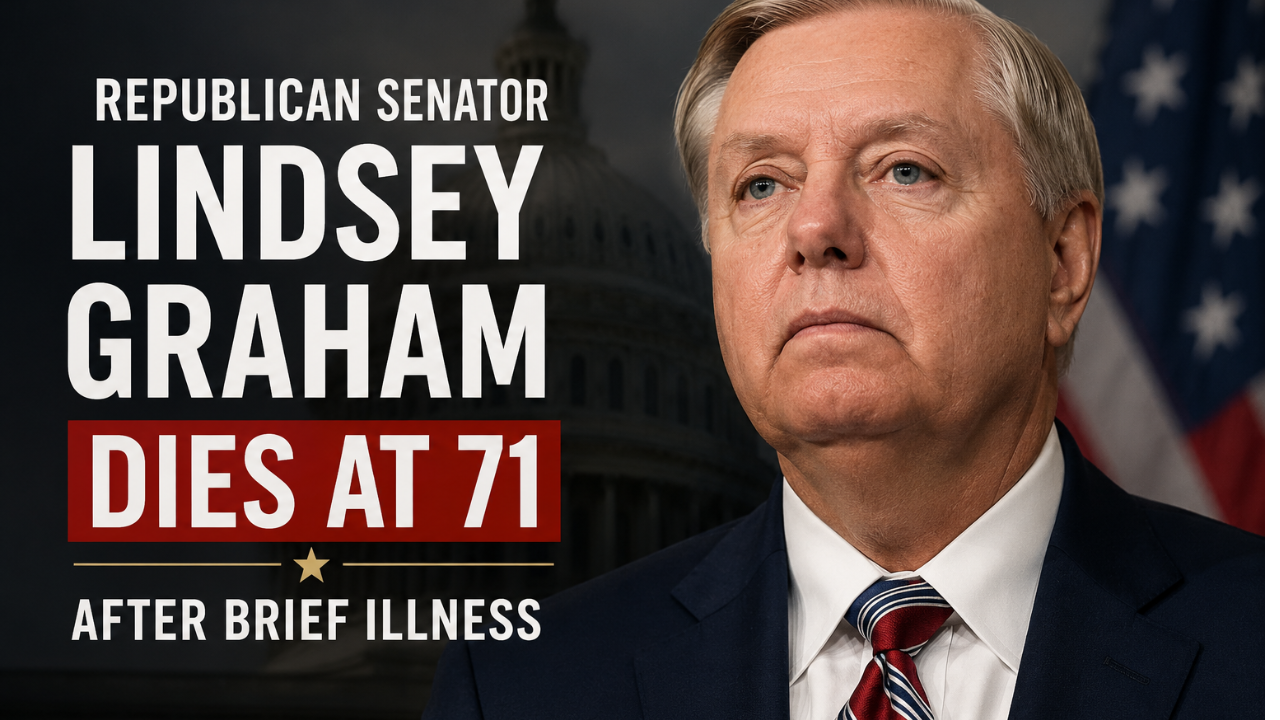
Senator Lindsey Graham of South Carolina has died at the age of 71, his office confirmed early Sunday, describing his death as the result of a “brief and sudden illness.” The news stunned Washington, arriving just hours after Graham had spoken by phone with President Trump, who later said the senator seemed tired but otherwise fine during that call. Emergency responders were called to Graham’s Washington home on Saturday night, and photographs obtained by NBC News showed paramedics carrying him from the residence to a waiting ambulance.
What We Know About the Cause of Death
Graham’s office said preliminary findings from the District of Columbia medical examiner pointed to an aortic dissection caused by arteriosclerotic cardiovascular disease, essentially a rupture of the aorta linked to hardened arteries. A staffer told NBC News there had been no earlier indication that the senator was feeling unwell. Graham had just returned from a trip to Ukraine, where he’d met with President Volodymyr Zelenskyy days before his death, and had been scheduled to appear on NBC’s “Meet the Press” the very morning his death was announced.
A Political Career Spanning Three Decades
Graham first came to Washington as a member of the House of Representatives in 1995, before winning the South Carolina Senate seat vacated by the retiring Strom Thurmond in 2002. Over more than two decades in the Senate, he built a reputation as a leading foreign policy voice, pressing both Trump and Biden administrations to back Ukraine’s fight against Russia and pushing for a hawkish U.S. stance on Iran. He also served 33 years in the Air Force, Air Force Reserve and South Carolina Air National Guard, retiring at the rank of colonel in 2015.
Tributes From Across the Political Spectrum
Reaction came swiftly and from far beyond U.S. borders. President Trump called Graham “one of the greatest people and Senators I have ever known” and ordered flags lowered to half-staff in his honor. Senate Majority Leader John Thune praised him as a strong advocate for the country and for America’s allies, while South Carolina Governor Henry McMaster described him as “irreplaceable.” International leaders weighed in too, with Ukrainian President Zelenskyy calling him a true defender of freedom, and Israeli Prime Minister Benjamin Netanyahu mourning the loss of both a political ally and a personal friend.
A Complicated, Colorful Legacy
Graham’s career was defined as much by his personal relationships as by his politics. He was known for close friendships that crossed party lines, including with the late Senator John McCain, and Illinois Senator Dick Durbin recalled working with Graham for months on immigration reform despite their frequent disagreements elsewhere. Graham’s personal story carried its own weight too, having grown up living with his family in a single room behind their liquor store, restaurant and pool hall in Central, South Carolina, and becoming his younger sister’s legal guardian after both of their parents died while he was still in school.
What Happens to His Senate Seat
Graham’s death immediately reshapes the Senate’s political landscape, coming at a difficult moment for a Republican conference already working with a narrow majority. His sister, Darline Graham Nordone, is set to be sworn in to complete his term, which runs through January 3, making her South Carolina’s first female senator. The sudden vacancy also introduces fresh uncertainty into ongoing Republican legislative priorities that Graham had been closely involved in shaping.
An Investigation Alongside the Grief
Adding a further layer to the story, federal agents, including nearly 20 FBI personnel, were reportedly present at Graham’s home in the days following his death, with the FBI describing its role as “assisting local authorities.” President Trump has publicly dismissed the need for such scrutiny, saying the FBI was “wasting their time” investigating the circumstances. For now, official reporting continues to point to natural causes tied to his cardiovascular condition, even as the additional law enforcement presence has drawn attention.
FAQs
1. What was the official cause of Lindsey Graham’s death?
Preliminary findings from the District of Columbia medical examiner pointed to an aortic dissection caused by arteriosclerotic cardiovascular disease, a rupture of the aorta linked to hardened arteries.
2. Did Lindsey Graham show any signs of being unwell before he died?
According to a top staffer, there was no indication he was feeling unwell beforehand. President Trump said he’d spoken with Graham by phone hours before his death and that, aside from seeming tired, he was fine.
3. Who will take over Lindsey Graham’s Senate seat?
His sister, Darline Graham Nordone, is set to be sworn in to complete the remainder of his term, which runs through January 3, becoming South Carolina’s first female senator.
4. Why were FBI agents reportedly at Graham’s home after his death?
The FBI has said it was “assisting local authorities,” though no evidence has emerged contradicting the preliminary medical finding of natural causes. President Trump has publicly downplayed the need for further investigation.
5. What was Lindsey Graham most known for during his Senate career?
He was widely recognized as a leading foreign policy voice, particularly on support for Ukraine and a hawkish stance toward Iran, along with a long, close political alliance with President Trump and cross-party friendships built over three decades in Congress.