A Queensland Council Leads the Way
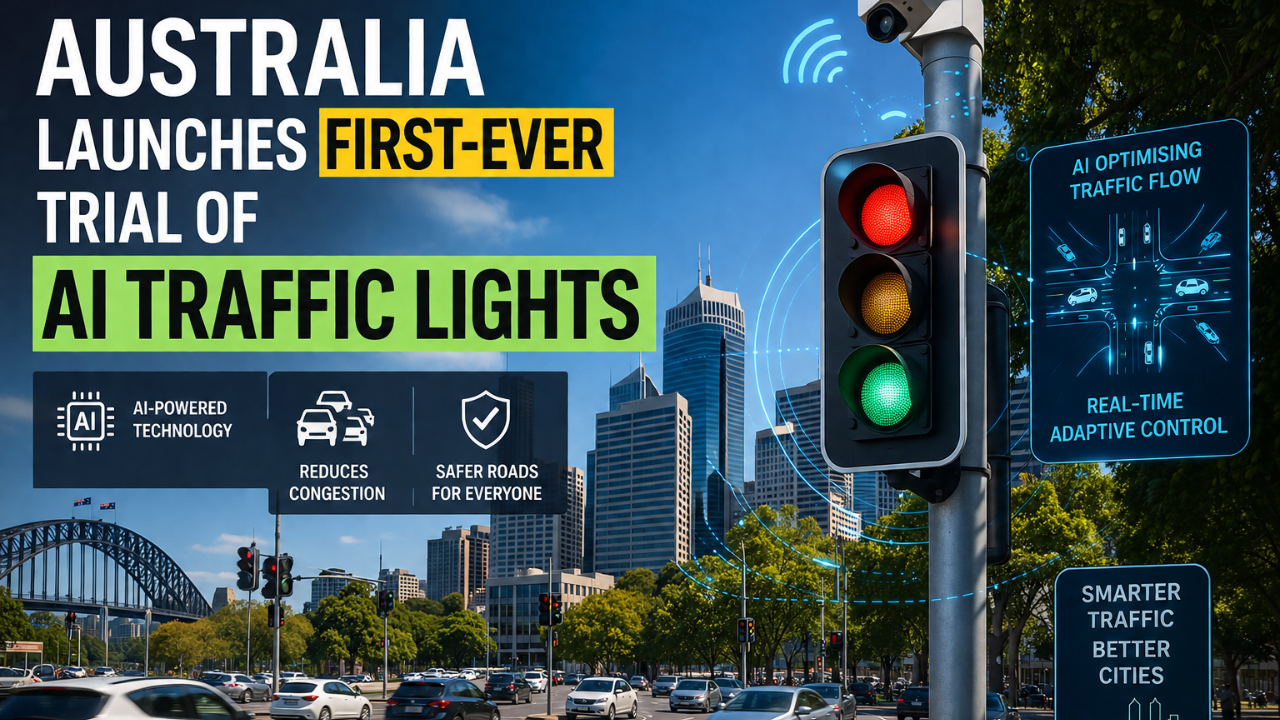
Every driver has sat at a red light with not a single car in sight, wondering why the signal won’t just change already. Queensland’s City of Moreton Bay Council thinks it has the answer, and it’s rolling out Australia’s first-ever trial of AI-powered traffic lights to prove it. The pilot is being billed as a genuine Australian first, replacing signal technology that in some cases dates back to the 1980s.
Where and When It’s Happening
The trial will kick off at the intersection of Moreton Parade and Paper Avenue in Petrie, right near the University of the Sunshine Coast’s Moreton Bay campus, later this year. It’s a sensible pick for a first test site, close to a university and existing traffic patterns that make for a useful real-world trial before council considers rolling it out anywhere busier.
How the Technology Actually Works
Traditional traffic lights run on fixed, pre-set sequences that don’t care whether the road is packed or completely empty, which is exactly why drivers end up stuck at red for no reason. The new system, supplied by Swarco, ditches that approach entirely. It uses CCTV cameras and LiDAR sensors to build a 3D map of the intersection in real time, then relies on AI algorithms to classify vehicles, cyclists and pedestrians and adjust signal timing on the fly based on what’s actually happening, rather than a rigid schedule.
What It’s Expected to Deliver
Swarco says similar deployments elsewhere have cut wait times by more than 10 percent while also reducing emissions and improving safety, since vehicles spend less time idling unnecessarily at empty intersections. Council also expects the system to dynamically prioritise buses and other public transport, rather than treating every vehicle the same regardless of how many people it’s carrying. Moreton Bay Mayor Peter Flannery said the technology has real potential to smooth out traffic flow across the council’s road network, and to cut down on the frustration of waiting at lights when there’s clearly no cross traffic.
Why This Matters for Australian Commuters
Traffic congestion is a genuine drain on Australian cities. The Inrix Global Traffic Scorecard found the average Brisbane commuter loses around 81 hours a year sitting in traffic, with Melbourne, Sydney, Adelaide and Perth not far behind. Most of these cities still rely on human operators adjusting signal timing manually from central traffic management centres, a method that struggles to keep up with real-time congestion. AI-driven signals offer a genuinely different way of managing that problem, reacting to conditions as they happen instead of following a schedule set months in advance.
Not Australia’s Only AI Traffic Experiment
This isn’t the first time AI has been tested on Australian roads, either. In Sydney, a ‘world-first’ trial at Manly used smart cameras and adaptive signals to manage huge, sudden surges of pedestrians pouring off ferries and buses, and reportedly cut risky pedestrian crossings by more than a third in 2025. The New South Wales Government has since flagged a second site for Parramatta CBD. Transport for NSW is also running its own separate trials of AI-powered thermal and optical cameras to improve bike detection at intersections in Bondi Junction and Surry Hills. Moreton Bay’s trial, though, is council’s first crack at using AI to manage full vehicle traffic flow rather than just pedestrian or cyclist detection.
What Comes Next
The roughly $170,000 installation at Petrie is just the starting point. Council has said that if the trial proves successful, it plans to expand the technology to busier, more complex intersections across the region. Given how widely this kind of system has already been used overseas, in cities like Washington D.C., Helmond, Tampere and Montevideo, there’s a decent chance Australian drivers could start seeing a lot more of these AI-controlled lights in the years ahead, assuming the Petrie trial delivers on its promise.
Quick Facts
| Detail | Information |
|---|---|
| Location | Moreton Parade & Paper Avenue, Petrie, QLD |
| Council | City of Moreton Bay |
| Technology supplier | Swarco |
| Sensors used | CCTV cameras + LiDAR |
| Expected wait-time reduction | 10%+ |
| Installation cost | ~$170,000 |
| Rollout | Later in 2026 |
| Expansion plan | To busier intersections if successful |
FAQs
1. Where is Australia’s first AI traffic light trial taking place?
It’s happening at the intersection of Moreton Parade and Paper Avenue in Petrie, north of Brisbane, in Queensland’s City of Moreton Bay.
2. How is this different from the traffic lights we already have?
Current signals run on fixed, pre-programmed sequences regardless of actual traffic volume. The new system uses cameras and LiDAR to read real-time conditions and adjusts each signal movement individually, rather than following a set schedule.
3. Will this system prioritise buses and cyclists over regular traffic?
Yes, the system is designed to dynamically prioritise higher-value traffic flows, like buses carrying many passengers, based on real conditions throughout the day rather than a fixed timetable.
4. How much will drivers actually notice a difference?
Based on results from similar systems overseas, wait times could drop by more than 10 percent, meaning less time sitting at red lights with no cross traffic in sight, and reduced idling-related emissions.
5. Will this technology roll out to other parts of Australia?
That depends on how the Petrie trial performs. Council has said it plans to test the system at more complex intersections if this initial trial proves successful, and similar AI-based pedestrian systems are already being trialled separately in Sydney.