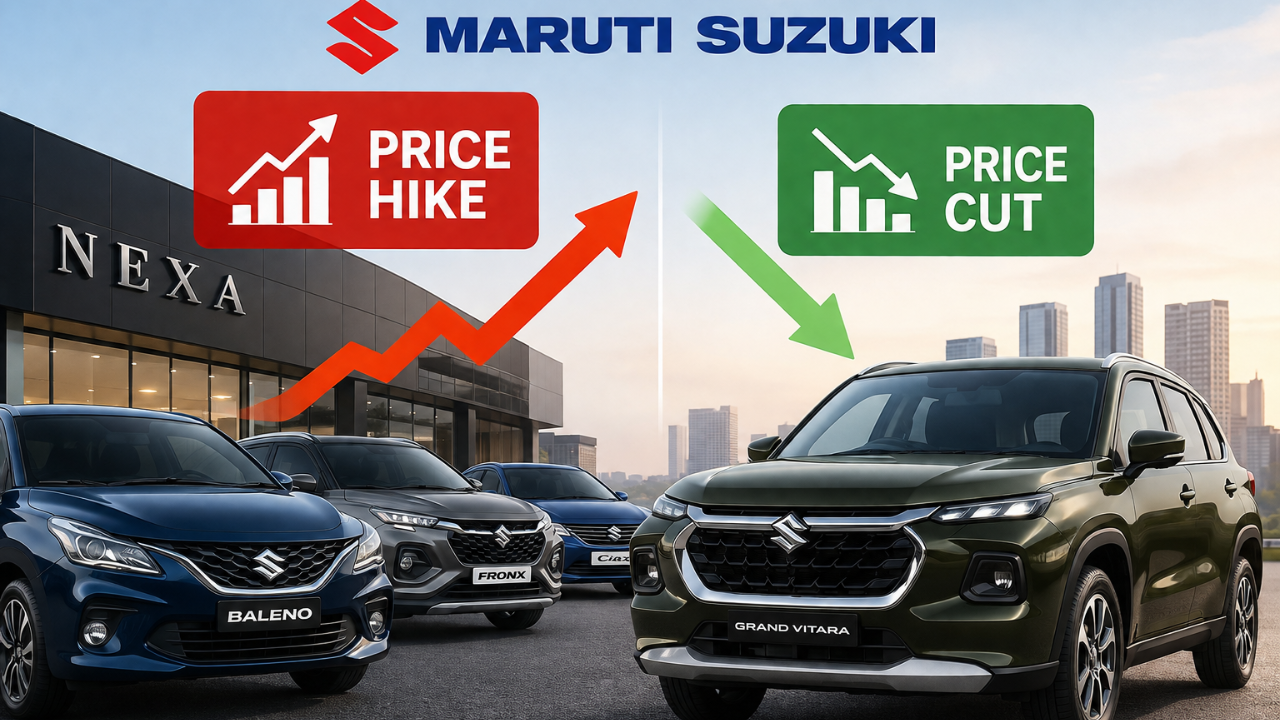
Maruti Suzuki has revised prices across its entire NEXA lineup as part of its second price hike of 2026. While models like the Baleno, Fronx, XL6, Jimny, e Vitara, and Invicto have become costlier by up to ₹30,000, the Grand Vitara bucks the trend with a price cut of up to ₹38,900 on select variants. New prices are effective immediately at all NEXA dealerships.
Why Has Maruti Suzuki Revised NEXA Prices?
This is Maruti Suzuki’s second price revision of 2026, following an earlier round of increases in January 2026. The company has officially attributed the hike to rising input costs, sustained inflationary pressure, and increasing logistics expenses that have made it difficult to absorb the full cost impact internally. Maruti Suzuki stated that it has been making continuous efforts to minimise the impact through internal cost reduction measures, but with the adverse cost environment showing no signs of easing, the company has decided to pass on a portion of the increase to customers — while keeping the hike model- and variant-specific, rather than applying a blanket increase across the board.
Importantly, the revision is not uniform. Entry prices on key volume models like Baleno and Fronx remain unchanged, ensuring the brand retains an accessible entry point. The biggest hikes are concentrated on the newly launched e Vitara electric SUV and the premium Invicto MPV — models where Maruti’s positioning allows for higher pricing. Meanwhile, the Grand Vitara goes against the grain entirely with a strategic price reduction on select mid-range variants.
Full NEXA Price Revision Summary Table
Here is a model-wise breakdown of all price changes across the Maruti Suzuki NEXA lineup, effective June 2026:
| Model | Segment | Price Change | Starting Price (Ex-Showroom) | Variants Affected |
|---|---|---|---|---|
| Baleno | Premium Hatchback | ↑ ₹5,000 – ₹7,500 | ₹5.99 Lakh (unchanged) | Delta, Zeta, Alpha (petrol & CNG); base Sigma unchanged |
| Fronx | Compact Crossover | ↑ ₹5,000 – ₹7,500 | ₹6.84 Lakh (unchanged) | Petrol variants +₹5,000; CNG variants +₹7,500 |
| Grand Vitara | Mid-Size SUV | ↓ Up to ₹38,900 | ₹10.76 Lakh | Select Zeta & Alpha Optional variants reduced; base and top-end unchanged |
| XL6 | Premium 6-Seat MPV | ↑ ₹5,000 – ₹10,000 | ₹11.52 Lakh | All petrol variants +₹5,000; CNG variants +₹10,000 |
| Jimny | Off-Road SUV | ↑ Moderate hike | Available at dealerships | Select variants revised upward |
| e Vitara | Electric SUV | ↑ Up to ₹30,000 | ₹15.99 Lakh | Higher trims see biggest impact; now priced ₹15.99L – ₹20.21L |
| Invicto | Premium MPV | ↑ Up to ₹25,000 | ₹24.97 Lakh | Zeta+ 8-seater +₹25,000 (now ₹25.27L); Zeta+ 7-seater & Alpha+ 7-seater unchanged |
Note: All prices are ex-showroom. On-road prices vary by city and state due to registration, road tax, and insurance charges.
Baleno: Moderate Hike, Entry Price Protected
The Baleno, now the most affordable NEXA model after the discontinuation of the Ignis, has received a price increase of ₹5,000 to ₹7,500 across most variants. The Delta CNG MT, Zeta CNG MT, Alpha Petrol MT, and Alpha Petrol AMT variants are now costlier by ₹7,500 each, while all other non-base variants have gone up by ₹5,000. Crucially, the base Sigma Petrol MT variant remains unchanged, keeping the Baleno’s entry price at ₹5.99 lakh (ex-showroom). The Baleno now ranges from ₹5.99 lakh to ₹9.17 lakh across petrol and CNG options with manual and AMT gearboxes. This approach of protecting the entry price while hiking higher variants is a deliberate strategy to retain footfall from budget-conscious buyers at NEXA showrooms.
Fronx: Compact Crossover Gets a Small But Noticeable Bump
The Fronx, one of Maruti’s strongest volume drivers in the compact crossover space, has received a moderate revision. Petrol variants are now costlier by ₹5,000, while CNG variants see a slightly higher hike of ₹7,500. Like the Baleno, the entry price of the Fronx remains intact at ₹6.84 lakh, ensuring the model continues to attract buyers from both the premium hatchback and compact SUV segments. The Fronx turbo-petrol variants, which have carved a niche among enthusiast buyers, are also affected by the revision, though the absolute price increase is small relative to their positioning.
Grand Vitara: The Surprise Price Cut
The Grand Vitara is the standout story of this price revision. While almost every other NEXA model saw a price increase, Maruti Suzuki has gone the other way with the Grand Vitara — cutting prices on select Zeta and Alpha Optional variants by up to ₹38,900. The base and top-end configurations remain unchanged in price.
This is a tactical move in one of India’s most competitive segments. The mid-size SUV space is crowded with strong rivals including the Hyundai Creta, Kia Seltos, Toyota Hyryder, Honda Elevate, Skoda Kushaq, and Volkswagen Taigun. A price correction on the high-volume mid-range variants of the Grand Vitara makes the SUV more competitive precisely where most buyers actually shop — not the base or the fully loaded top trim, but the value-rich middle. The Grand Vitara currently starts at ₹10.76 lakh (ex-showroom) and goes up to ₹19.72 lakh for the Strong Hybrid Alpha+ variant.
XL6, Jimny, e Vitara & Invicto: What’s Changed
The XL6, Maruti’s premium six-seat MPV, has become costlier across all variants — petrol versions are up by ₹5,000 and CNG variants by ₹10,000, bringing the starting price to ₹11.52 lakh. The Jimny, the rugged lifestyle SUV, has also seen a moderate upward revision on select variants.
The e Vitara — Maruti Suzuki’s first-ever electric SUV launched earlier in 2026 — takes the biggest proportional hit, with higher trims becoming costlier by up to ₹30,000. It now carries a price range of ₹15.99 lakh to ₹20.21 lakh (ex-showroom). The Invicto, Maruti’s flagship premium MPV developed in collaboration with Toyota and sharing its platform with the Innova Hycross, sees a ₹25,000 hike on the Zeta+ 8-seater variant, which now costs ₹25.27 lakh. The Zeta+ 7-seater (₹24.97 lakh) and Alpha+ 7-seater (₹28.60 lakh) prices remain unchanged in this revision.
What Does This Mean for Buyers?
For buyers planning a NEXA purchase, the impact depends heavily on the model and variant selected. The Baleno and Fronx hikes are small enough that dealer-level offers, exchange bonuses, and corporate discounts can comfortably offset the increase for most buyers. The XL6 and Invicto hikes are more noticeable but still within single digits as a percentage of the ex-showroom price.
The e Vitara’s ₹30,000 increase on higher trims is the most significant in absolute terms and may push some electric SUV buyers to reconsider rival offerings such as the Tata Nexon EV or Hyundai Creta Electric. On the flip side, the Grand Vitara price cut is a clear opportunity — buyers considering mid-spec Zeta and Alpha Optional variants of the Grand Vitara now get a better deal than they did a month ago, making it a compelling time to lock in a booking before any future corrections.
Maruti Suzuki has been posting strong overall volumes with record domestic sales, which gives the company room to implement such calibrated adjustments without significantly affecting momentum. Price-sensitive buyers are advised to compare variant-level value, check current dealer offers, and confirm the latest on-road price at their nearest NEXA showroom before finalising a purchase.
Frequently Asked Questions (FAQ)
Q: When did the Maruti NEXA price revision take effect?
The revised prices are effective immediately at all NEXA dealerships across India as of June 2026. This is Maruti Suzuki’s second price hike of the year, following an earlier revision in January 2026.
Q: Which NEXA model has seen the biggest price hike?
The e Vitara electric SUV and the Invicto MPV have seen the sharpest increases — up to ₹30,000 on higher e Vitara trims and up to ₹25,000 on the Invicto Zeta+ 8-seater variant.
Q: Has the Grand Vitara become costlier or cheaper?
The Grand Vitara is the exception — it has actually become cheaper. Maruti Suzuki has reduced prices on select Zeta and Alpha Optional variants by up to ₹38,900. The base and top-end Strong Hybrid variants remain unchanged in price.
Q: Has the starting price of the Baleno changed?
No. The base Baleno Sigma Petrol MT remains unchanged at ₹5.99 lakh (ex-showroom). The price increase of ₹5,000 to ₹7,500 applies to higher variants — Delta, Zeta, and Alpha — in both petrol and CNG options.
Q: Has the starting price of the Fronx changed?
No. The entry price of the Fronx remains at ₹6.84 lakh (ex-showroom). The hike of ₹5,000 (petrol) and ₹7,500 (CNG) applies to non-base variants.
Q: Why is Maruti hiking prices in 2026?
Maruti Suzuki has cited rising input costs, sustained inflationary pressure, and higher logistics expenses as the primary reasons. The company says it has been absorbing costs internally for several months but can no longer offset the full impact without passing a portion on to customers.
Q: Is the e Vitara now more expensive than rivals?
The e Vitara now ranges from ₹15.99 lakh to ₹20.21 lakh (ex-showroom) after the revision. This puts it in direct competition with the Hyundai Creta Electric (from ₹17.99 lakh) and Tata Nexon EV (from ₹13.99 lakh), making variant selection critical for buyers evaluating electric SUVs.
Q: Should I book a NEXA car now or wait?
If you are considering a Baleno or Fronx, the entry-level variant pricing is currently protected and dealer-level offers may offset the mid-variant hikes. If you are considering a Grand Vitara, the current price cuts on Zeta and Alpha Optional variants represent a good window to buy. For the e Vitara and Invicto, the hike has already taken effect — waiting further is unlikely to bring prices down unless Maruti announces a correction. Always confirm the final on-road price at your nearest NEXA dealership, as charges vary by state.
Q: Which Invicto variants have been affected?
Only the Zeta+ 8-seater variant of the Invicto has been revised upward — it is now priced at ₹25.27 lakh (up by ₹25,000). The Zeta+ 7-seater at ₹24.97 lakh and Alpha+ 7-seater at ₹28.60 lakh remain unchanged in this revision.